
I remember one particularly intense blackjack game. The air was thick with anticipation, the clatter of chips a constant hum. I was dealt a stiff hand – a ten and a six, sixteen. The dealer showed a seven. The gut reaction? Hit. But years of studying blackjack strategy screamed otherwise. I stood my ground, stomach churning. The dealer flipped a ten, sealing their fate and mine. Victory! That feeling, the rush of outsmarting the odds, is what fuels my passion for blackjack.
We all know the sinking feeling of busting, watching our hard-earned chips disappear. It’s frustrating, demoralizing, and entirely avoidable more often than not. Forget those empty promises of guaranteed wins. Blackjack is a game of calculated risk, and this article is about equipping you with the knowledge to minimize that risk and maximize your chances of success.
Consider this your personal strategy guide, packed with actionable techniques to improve your blackjack game. I will not make you any false promises, just provide you with the tools and expert insight to reduce those dreaded busts and start playing smarter.
In this comprehensive guide, you’ll discover expert-backed strategies, for instance how to make the most of your decisions, ultimately transforming you into a more confident and successful player.
Blackjack Basics: A Quick Refresher
Before diving into advanced strategies, let’s ensure we’re all on the same page with Blackjack’s fundamental rules. Consider this a quick pit stop to refresh your memory or, if you’re new to the game, a starting point to understanding it.
- Card Values: Numbered cards (2-10) are worth their face value. Face cards (Jack, Queen, King) are each worth 10. An Ace can be worth either 1 or 11, depending on which value benefits the hand more.
- Objective: The goal is to have a hand value higher than the dealer’s, without exceeding 21. Going over 21 is called “busting,” and results in an automatic loss.
- Dealer’s Rules: The dealer must “hit” (take another card) if their hand totals 16 or less and must “stand” (stop taking cards) if their hand totals 17 or more.
Key Terms:
- Hit: To request another card.
- Stand: To end your turn without taking any more cards.
- Double Down: To double your initial bet and receive only one additional card. This is typically done when you have a strong starting hand.
- Split: If you have two cards of the same value, you can split them into two separate hands, each requiring an additional bet.
- Insurance: If the dealer’s face-up card is an Ace, you can purchase insurance, a side bet that pays out if the dealer has Blackjack (a hand totaling 21).
Understanding these basic blackjack rules and terms is crucial before moving onto more complex strategies. This refresher ensures you have a solid foundation for improving your game.
Understanding the Odds: Why Busting Happens
Blackjack, at its heart, is a game of probabilities. Understanding these probabilities is crucial to minimizing losses and maximizing winnings. The concept of “busting,” exceeding a hand value of 21, looms large in every player’s mind because it results in an automatic loss, regardless of the dealer’s hand.
One of the fundamental concepts to grasp is the house edge. In blackjack, the house inherently holds a slight mathematical advantage, baked into the rules of the game. This advantage manifests itself in several ways, including the dealer acting last. However, the player’s decisions significantly influence how large that house edge becomes.
A key factor in busting probability is the prevalence of high-value cards (10, Jack, Queen, King) in the deck. Approximately one-third of the deck consists of cards valued at 10. This means that any hand totaling 12 or more carries a substantial risk of busting with the next hit. The exact probability varies depending on the player’s current hand value and the dealer’s visible card as well. For example, with a hand totaling 16, the player faces around a 62% chance of busting on the next hit. This is because any card higher than a 5 will cause them to go over 21.
While basic strategy charts provide guidelines on when to hit or stand, some advanced players attempt to further influence the odds using card counting techniques. Card counting involves tracking the ratio of high cards to low cards remaining in the deck. Although controversial and often frowned upon by casinos, card counting aims to give players an understanding of when the odds are shifting in their favor.
Ultimately, mastering blackjack demands a firm grasp of probabilities. Without understanding the underlying odds, players are at the mercy of chance. Recognizing the likelihood of busting forms the bedrock of informed decision-making, setting the stage for more strategic gameplay. Learn the odds and manage the risks.

The Core Strategy: Mastering the Hit/Stand Decision
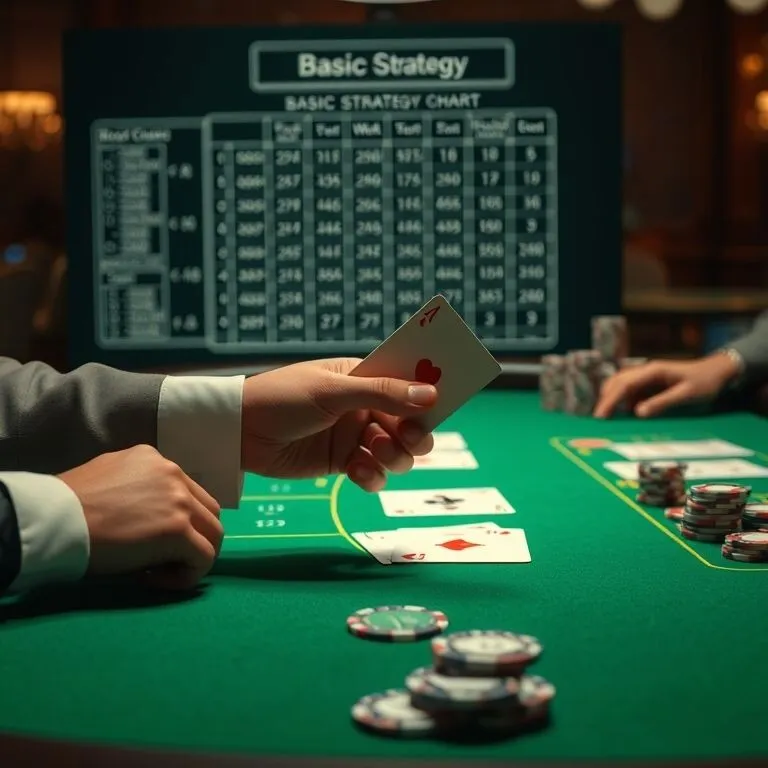
Blackjack isn’t just about luck; it’s a game of calculated decisions. At the heart of any successful blackjack strategy lies the blackjack basic strategy chart, your go-to guide for minimizing the house edge. Think of this chart as your personal blackjack guru, whispering the optimal move in your ear for every possible scenario. It’s not some magic trick, but refined knowledge build on millions of simulated blackjack hands.
The hit/stand chart works by cross-referencing your hand with the dealer’s upcard. Find your hand along one axis and the dealer’s card along the other, and where they intersect reveals the statistically best action: hit, stand, double down, or split. Let’s say you have a 12 and the dealer shows a 4. The chart will tell you the optimal move is to stand. Or if you’re holding a soft 17 (an Ace counted as 11, plus a 6) against a dealer’s 8, the chart will show that hitting is the better option.
Following the blackjack strategy chart might feel counterintuitive at times, especially when your gut tells you to do something different. But trust the math! Consistently using the chart improves your chances of winning in the long run and significantly reduces the risk of busting. Different casinos have slight rule variations, therefore, the optimal strategy adjusts, especially what the dealer does on a soft 17(a hand of ace and a 6): hit or stand. Make sure your chart matches the specific rules of the game to get the most from it!
When to ALWAYS Hit (and When to NEVER Hit)
For a quick memory aid, here’s a cheat sheet based on the optimal strategy: Always hit when you have 11 or less. There’s no risk of busting, and you need to improve your hand. On the flip side, never hit when you have a hard 17 or higher. The risk of busting outweighs the potential reward. Knowing these ‘always’ and ‘never’ scenarios provides a solid foundation, but mastering the full blackjack basic strategy chart is the real key to unlocking your blackjack potential.
Advanced Strategies: Beyond the Basics
Venturing beyond basic blackjack strategy opens the door to advanced techniques like card counting and shuffle tracking. While these methods can potentially shift the odds in your favor, it’s crucial to understand their complexity and the inherent risks involved. These techniques need to be applied with caution; it’s more important to rely on fundamental skills for an enjoyable experience.
Card counting, at its core, involves assigning values to cards (positive for low cards, negative for high cards) and tracking the running count in your head. The idea is that a high count indicates a higher proportion of high-value cards remaining in the deck, making it more advantageous to bet higher. However, mastering card counting requires serious dedication, sharp memory, and the ability to perform calculations under pressure.
Furthermore, casinos are well aware of card counting and employ various methods to detect and deter it. If you’re suspected of card counting, you might be asked to leave. Therefore, any attempt at card counting should be discreet, and you must be acutely aware of your surroundings.
Shuffle Tracking Tips
Shuffle tracking takes advantage of the fact that even with sophisticated shuffling techniques, cards or groups of cards can sometimes clump together. By carefully observing the shuffling process, a skilled player might be able to predict where certain cards or sequences of cards will end up in the deck. This often involves recognizing patterns and estimating the effects of the shuffle. Card clumping is a common effect that causes certain cards to group together. It is vital to detect these patterns that will take time to be noticed, and constant vigilance is needed.
Casinos are vigilant about these kinds of skills, so tread carefully. The landscape in casino games is complicated, and understanding it can protect from making the wrong move.
Bankroll Management: Playing the Long Game
Blackjack, when approached strategically, can be an engaging and potentially rewarding endeavor. However, success hinges on more than just understanding basic strategy; it demands disciplined bankroll management. Think of your bankroll as your investment capital in a business – reckless spending will inevitably lead to ruin.
The cornerstone of effective bankroll management is setting a blackjack budget. This isn’t just about allocating funds; it’s about defining your risk tolerance. Only wager what you can comfortably afford to lose without impacting your financial well-being. Treat it as an entertainment expense, like going to the movies or a concert. Once that budget is depleted, step away.
Bet sizing is the next critical element. A common guideline is to wager no more than 1-2% of your total bankroll on a single hand. This minimizes the impact of losing streaks and allows you to weather the inevitable ups and downs of the game. Bigger isn’t better; consistent, controlled betting is the key.
Avoid chasing losses like the plague. It’s a psychological trap that leads to reckless decisions and bigger losses. There was a time when I was playing quite well. I’ve won three sessions in a row and felt like I’m on top of the world. I was betting around 2% of my bankroll, but after a few quick losses, I started doubling down more aggressively to try and recoup my money faster. Next thing I knew, I had lost almost half of my bankroll in a single session. That was tough lesson.
Blackjack shouldn’t be viewed as a get-rich-quick scheme, but as a long-term strategy, a marathon, not a sprint. Discipline, patience, and sound bankroll management are your best tools for navigating the journey.
Staying Disciplined: The Mental Game of Blackjack
Blackjack, at its core, is a game of probabilities. But anyone who’s spent time at the table knows that winning consistently requires more than just memorizing basic strategy. The mental game, the ability to stay disciplined even when the cards aren’t falling your way, is what separates the amateurs from the players who grind out a profit.
One of the biggest threats to blackjack discipline is “tilt.” In simple terms, going on tilt means letting emotions – frustration, anger, or even overconfidence – dictate your decisions. You might start chasing losses with bigger bets, deviate from basic strategy, or make impulsive plays you wouldn’t normally consider. Recognizing the signs of tilt – a racing heart, clenched fists, or negative self-talk – is the first step to combating it. When you feel tilt creeping in, step away from the table. A short break to clear your head can prevent costly mistakes.
Even when you’re not actively tilting, maintaining emotional control is crucial. Blackjack is a game of variance; streaks of bad luck are inevitable. Sticking to basic strategy, even when losing, is paramount. Trust the math; it’s designed to give you the best possible odds in the long run. I remember one particularly brutal session where I lost six hands in a row. The urge to double down on a bad hand just to “get even” was almost overwhelming. But I stuck to the strategy, and eventually, the tide turned. That disciplined approach is what transformed my game for the better.
Techniques like meditation and deep breathing, while seemingly unrelated, can profoundly impact your ability to stay calm under pressure. Incorporating these practices into your daily routine can improve your focus and emotional resilience, translating to better decision-making at the blackjack table. Remember the mental fortitude, as much as the strategy know-how, is your key to victory.
Common Mistakes to Avoid & Expert Tips
Even seasoned blackjack players can fall into traps that significantly decrease their odds of winning. Recognizing these common errors and learning how to avoid them is crucial for improving your game.
- Ignoring Basic Strategy: This is arguably the biggest mistake. Basic strategy is a mathematically derived set of optimal plays for every possible hand you can have against each dealer upcard. Deviating from it, even slightly, gives the house a bigger edge. Expert Tip: Commit basic strategy to memory or use a strategy chart. A small investment in learning the chart pays massive dividends.
- Taking Insurance: Insurance bets seem tempting when the dealer shows an Ace, but they are almost always a bad bet. The odds of the dealer actually having blackjack are less than the payout for the insurance bet. Expert Tip: Unless you are counting cards and know the deck is rich in tens, avoid the insurance bet.
- Splitting Tens: Splitting a pair of 10s is generally a losing proposition. You’re breaking up a strong hand (20) in the hopes of making two even stronger hands, but the odds are against you. Expert Tip: Stand on a pair of 10s against any dealer upcard.
- Hitting on 16 Against a Dealer’s 10: This feels like a terrible situation, but hitting is statistically the better option, even though it’s nerve-wracking. Expert Tip: While it feels counterintuitive, hitting gives you a slightly better chance of winning in the long run than standing.
- Not Managing Your Bankroll: Playing without a set budget and staking plan is a recipe for disaster. Chasing losses or betting too much per hand can quickly deplete your funds. Expert Tip: Determine a bankroll before you start playing and stick to a predetermined bet size that represents a small percentage of your total bankroll.
Blackjack, at its heart, is a game of probabilities. By understanding these probabilities and consistently making mathematically sound decisions, you can significantly improve your chances of winning and minimize the house edge.
Conclusion
Mastering blackjack strategy is a journey, not a destination. By consistently applying basic strategy and managing your bankroll wisely, you significantly improve your winning odds. Blackjack rewards skill and patience. Practice in a low-stakes environment, like free online games, to hone your skills before playing for real money. Consistency and discipline are your greatest allies at the blackjack table.